

About Classic Rock:
Classic rock stands as the enduring heartbeat of modern guitar music — a sound born from the late 1960s and 1970s that fused blues roots, melodic songwriting, and electrified energy into a timeless form. It’s not just a style; it’s the foundation of rock’s identity, shaping generations of musicians and listeners alike.
At its core, classic rock celebrates authentic performance — real instruments, powerful vocals, and songs built to last. The genre’s golden era was defined by artists who turned rebellion and artistry into anthems that still echo through stadiums and playlists today.
Key Bands That Defined the Era
The Beatles – Their evolution from pop innovators to studio visionaries set the creative standard for rock music.
The Rolling Stones – Masters of swagger and blues‑driven grit, they embodied rock’s attitude and longevity.
Led Zeppelin – Fused hard rock, blues, and mysticism into a monumental sound that influenced nearly every band that followed.
The Who – Explosive live performers who pioneered rock opera and pushed the boundaries of storytelling in music.
Pink Floyd – Crafted immersive, conceptual albums that blended progressive rock with emotional depth and sonic experimentation.
Queen – Combined theatrical flair with technical brilliance, creating anthems that transcended genre and generation.
AC/DC – Delivered pure, riff‑driven power with relentless energy and unmistakable simplicity.
Aerosmith – Brought bluesy swagger and arena‑sized hooks to American rock, bridging classic and modern styles.
Fleetwood Mac – Blended harmony‑rich songwriting with emotional complexity, defining the softer side of classic rock.
Why Classic Rock Endures
Classic rock remains vital because it captures the essence of human connection through sound, the warmth of analog instruments, the storytelling in lyrics, and the emotional charge of live performance. Its influence runs through every modern genre, from alternative to metal, reminding listeners that great rock is built on authenticity, melody, and soul.
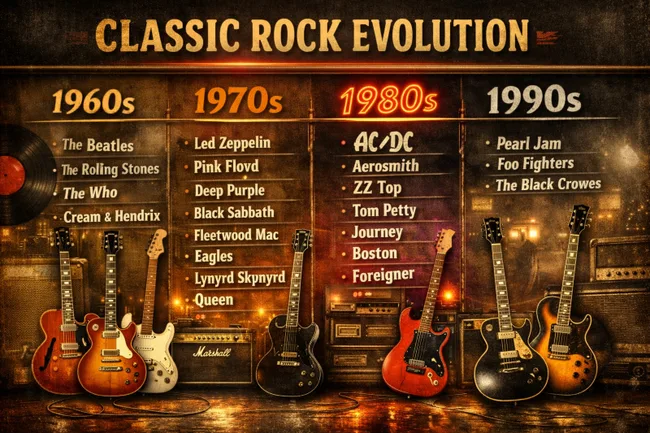
Classic Rock — Evolution Timeline
1960s: The Revolution Begins
- The Beatles redefine popular music with inventive songwriting and studio experimentation.
- The Rolling Stones inject blues grit and rebellious swagger into rock’s DNA.
- The Who explode onto the scene with power chords and theatrical energy.
- Cream and Jimi Hendrix push guitar virtuosity into new dimensions.
1970s: The Golden Era
- Led Zeppelin blend mysticism and heavy blues to create the blueprint for hard rock.
- Pink Floyd expand rock’s boundaries with conceptual albums and immersive soundscapes.
- Deep Purple and Black Sabbath lay the groundwork for metal’s emergence.
- Fleetwood Mac, Eagles, and Lynyrd Skynyrd bring melody and storytelling to the mainstream.
- Queen fuse operatic drama with arena‑sized hooks, redefining rock spectacle.
1980s: Legacy and Influence
- AC/DC dominate with pure riff‑driven power.
- Aerosmith and ZZ Top keep blues‑based rock alive with swagger and precision.
- Tom Petty and the Heartbreakers deliver timeless songwriting that bridges generations.
- Journey, Boston, and Foreigner refine the polished, radio‑friendly side of classic rock.
1990s–Present: Enduring Impact
- Classic rock becomes the foundation of modern rock, influencing grunge, alternative, and metal.
- Bands like Pearl Jam, Foo Fighters, and The Black Crowes carry forward its spirit of authenticity.
- The genre remains a living legacy, celebrated through radio, festivals, and new generations discovering its timeless sound.
For The Latest Classic Rock News On All Bands, Visit: Classic Rock News
For our Classic Rock Band Directory with biographies, links, and discographies. etc., visit: Classic Rock Band Directory